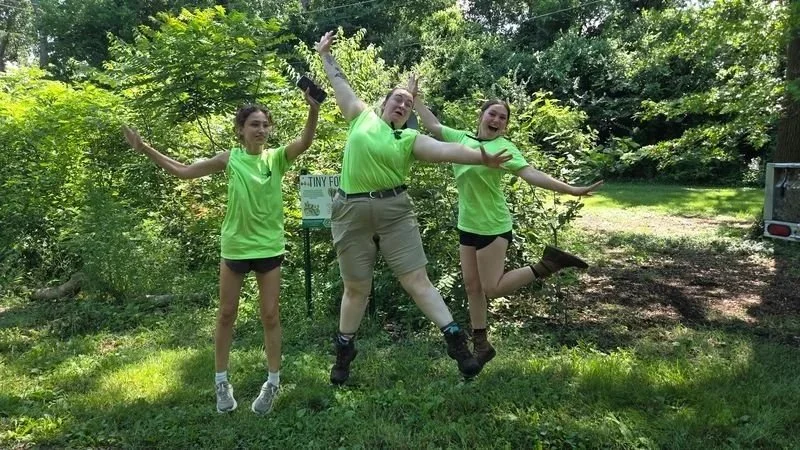
Author: De’Nonna Jones, Forest Releaf
Here at Forest ReLeaf we take pride in the way we care for trees. We spend hours planting trees in the winter and fall and hope to water those same trees (and more) during the summer. During the early weeks of this summer, we were reminded that trees need more than water in order to thrive in urban environments. Let’s dig into what else they might need. But first, a quick introduction to our stewardship team this summer.
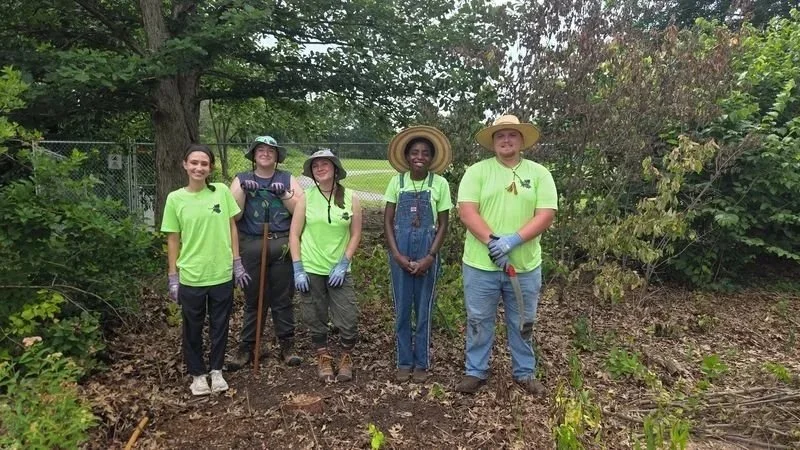
At the end of May, we welcomed Sara Blandina, Quinn Swope, and Liz Schmidt to our canopy crew. We also gave a big welcome back to Sam LaPorte. He is returning for his 4th summer with us, this time as our assistant crew lead. During their first week, the crew spent time learning the in and outs of Forest ReLeaf and what role they would play in supporting our mission of building St. Louis’ urban canopy. We spent time using a dichotomous key in order to identify some of the mature trees surrounding our office. Most of our summer is spent caring for trees that are in the early stages of their lives, so I find it important to engage the crew with trees that are in later stages. The mature trees give us an idea of what we're working towards. When we plant trees in urban parks, we want to make sure that the conditions are near perfect so that it can live a long, healthy life. Every tree we water during the summer was planted in what our forestry manager Billy Haag, refers to as “the million dollar hole”. This is the space that the tree will live in for the rest of its life so it’s important to give it a good start. From there, it's up to our canopy crew to nurture these trees during times of stress, specifically a hot summer in St. Louis, MO.
Each week we water over 1,000 trees. We give each tree 10 gallons of water a week. This is what we told the canopy crew in their interviews and what we prepared them for during orientation week. However! Nature had other plans. There is only 1 condition where we do not have to water a tree and that is when it rains at least 1.5 inches. This condition was met for the first 2 weeks of June, which lead to an unpredictable start to our summer together. For the first few weeks of the season we learned a valuable lesson about working in the green field; the weather does what it wants. As inconvenient as it was for us, it was a huge help for the trees and for that we can’t be too mad. We are a tree centered organization afterall. With that in mind, what then, could we do for the trees if watering was covered?
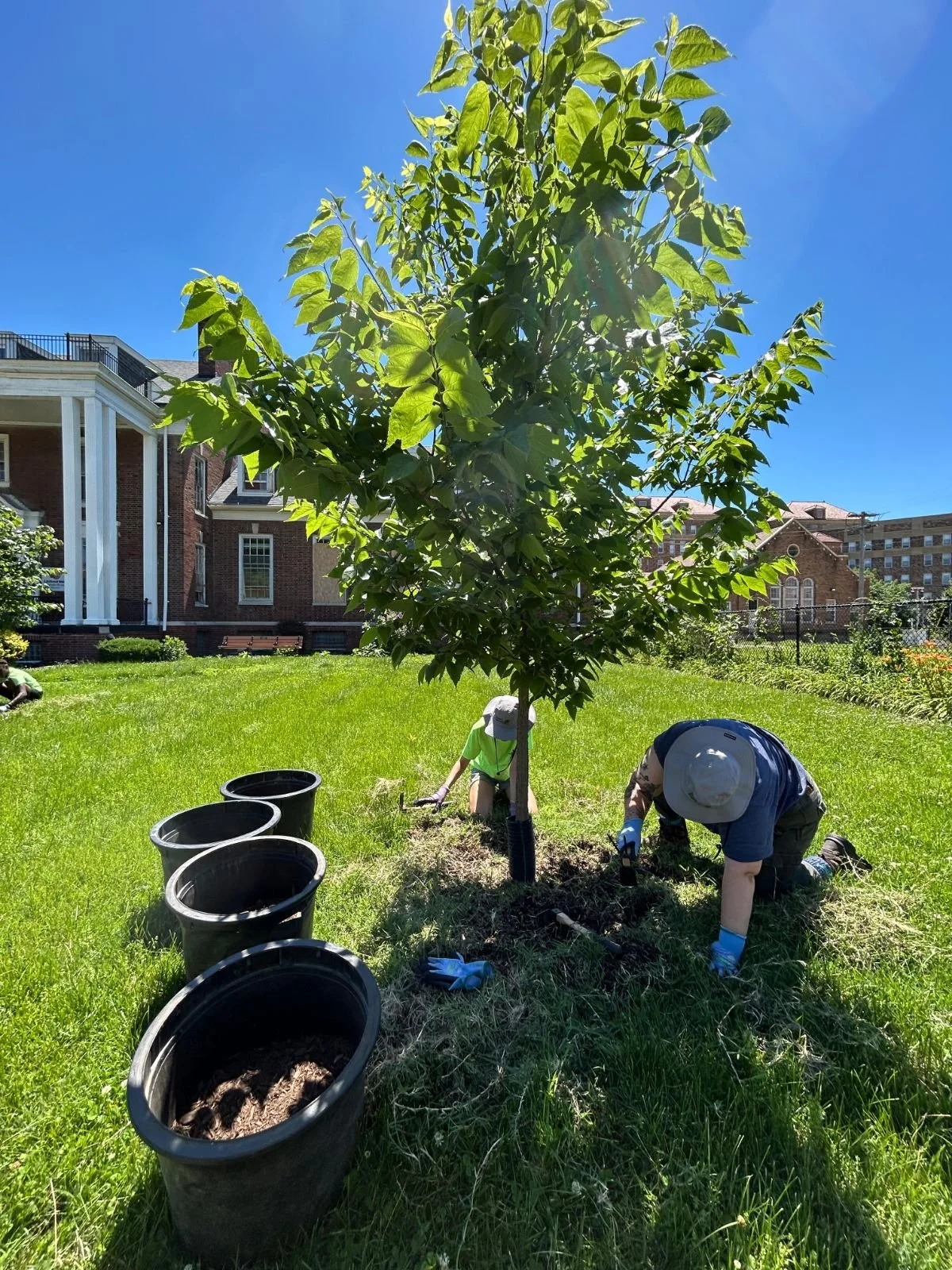
We pivoted to 2 tasks that are just as essential to a tree's survival in an urban environment. The first was building a mulch ring around its trunk. Mulch is very important to the survival of trees that are planted in urban spaces. The mulch ring must follow the 4x4x4 rule in order to be effective. It must spread 4 feet around the trunk of the tree. The outer edge of the ring should end right at the edge of the tree’s drip line or extend a bit beyond it. This creates a wall of protection and visibility for mowers. The ring must be 4 inches deep in order to suppress weeds which ideally results in there not being a need to bring a mower close to the tree. Lastly, the center of the ring is 4 inches away from the trunk of the tree. This creates a bowl for watering, and allows space for the trunk to taper. Trunk tapers are essential for the stability of the tree. We spent 2 weeks perfecting this formula of 4 and 4 and 4, over and over again. We now dream of mulch rings, and cringe at the hundreds of mulch volcanoes we see all over the city.
Another important piece of tree planting is data collection. We want to make sure that the trees we plant are still there when we walk away. When the mulching is done, we spend the afternoon performing inventories. That means visiting the parks where we planted trees over 3 or more years ago, and making sure they haven’t walked away. We take note of their health, their mulch rings, and if they look as if they have been cared for. This data helps us to keep track of our mortality rates and our overall tree happiness. If a tree has survived 2 years, it'll survive at least 50 more right? Right??
These past few weeks we learned how to play on a team with mother nature herself. She took care of the watering, while we took care of mulching and documentation. We love teamwork! For the rest of the summer, we will continue this trade off with mother nature. She’ll provide the sunshine for the trees and we’ll water them. We are looking forward to a summer of watering!